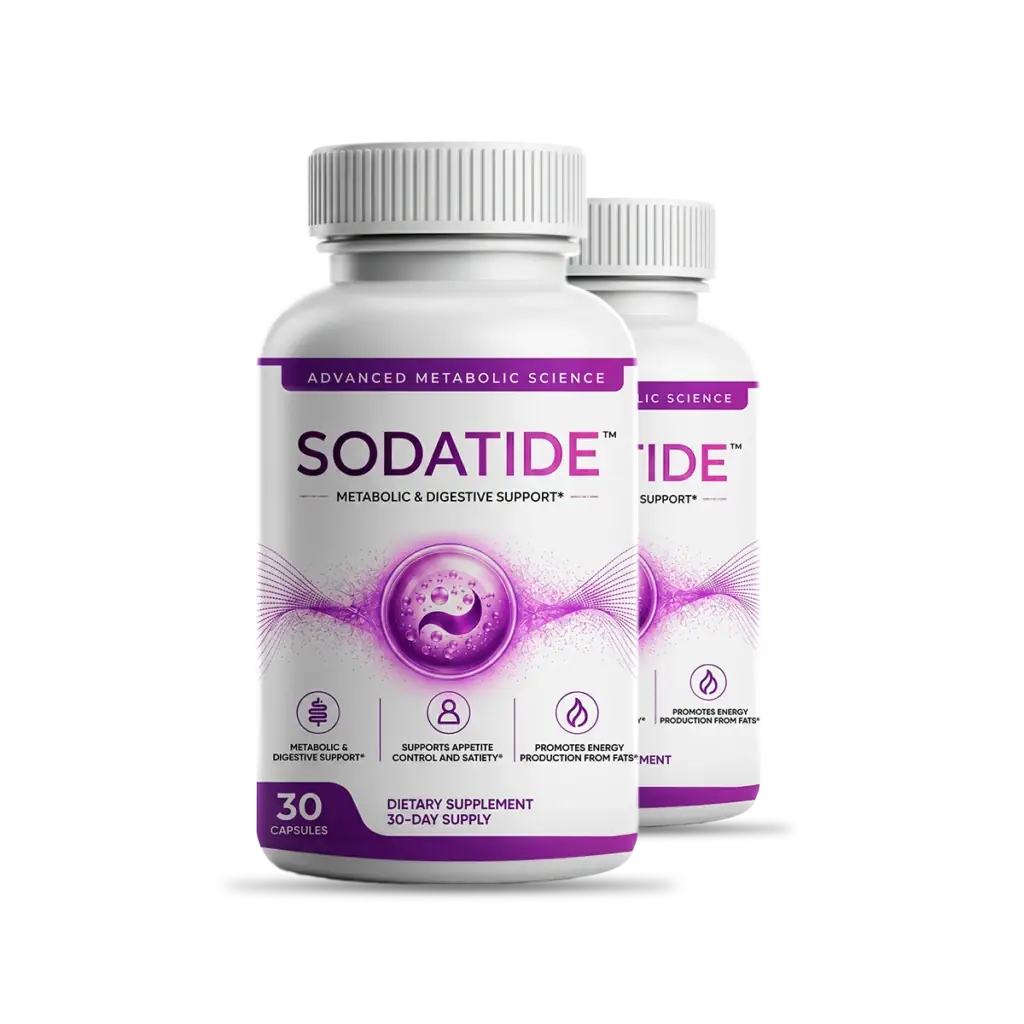
The SodaTide amounts the sales page never gives
The seller's page names three ingredients and describes a three-strain probiotic blend.
It publishes no amount for any of them, anywhere — no milligrams,
no CFU count — and it names only one of the three strains.
The product label publishes nearly all of it. The Supplement Facts panel
on the bottle carries the milligram amounts and names all three strains. Read directly
from the label:
IngredientPer capsuleCommonly studied at
Chicory Root Inulin211 mg
5,000–10,000 mg a day in prebiotic trials
Potato Resistant Starch100 mg
15,000–30,000 mg a day in most studies
Probiotic Blend36 mg
Measured in CFU, not milligrams — no CFU published
Total active material347 mg
One capsule, once daily
The three strains, also named in full on the label:
Bifidobacterium infantis, Clostridium butyricum and
Akkermansia muciniphila. The sales page names only the third.
Why this matters. Without amounts, a named ingredient list cannot be
checked against anything. With them, the comparison is simple arithmetic:
211 mg of inulin is roughly one twenty-fifth to one fiftieth of a studied
prebiotic dose, and 100 mg of resistant starch is roughly one hundred-and-
fiftieth to one three-hundredth of one.
That is not concealment — the numbers are printed on the bottle, and anyone can
read them. It is a physical constraint: fibre is bulky, and a single small
capsule cannot hold a gram-scale dose of it. Anyone eating a bowl of oats, a
pear or a serving of beans takes in several grams of fermentable fibre. It is the fact
that matters most when judging what one capsule a day can realistically do.
No CFU count is published for the SodaTide probiotic blend
The label declares the probiotic blend by weight — 36 mg. That is
the one figure on the panel that cannot be interpreted.
Probiotics are dosed in colony forming units, not milligrams. A CFU
count measures how many live organisms you actually swallow. A weight tells you how much
powder is in the capsule, and that powder is mostly carrier material. Two products both
declaring 36 mg could differ by several orders of magnitude in live organisms, and
nothing published distinguishes them.
Typical probiotic research uses doses in the region of one to fifty billion CFU a day,
and trials report the figure because it is the variable that matters.
What this means practically: the strains are named, which is better than
most blends manage, but the amount of live culture cannot be established from any
published source. That is a fair question to put to the seller before ordering six
months' worth.
How to read the research behind SodaTide
The ingredient categories here are genuinely researched. Inulin is one of the
best-characterised prebiotics there is; resistant starch has reasonable evidence for
insulin sensitivity; and Akkermansia muciniphila is among the most actively
studied organisms in metabolic research.
Two things follow that the seller's page does not say. That research concerns the
ingredient categories, not this finished product, which has never been through a
clinical trial of its own. And the research was conducted at grams per day
of fibre, against 347 mg of total active material here.
The research explains why these ingredients are interesting. It does not show that this
capsule reproduces the results.